
Common solar scams and how to avoid them
Let’s start with the obvious: Most solar installers do great work, provide great customer service, and support you through — and beyond — the installation process. (Especially the installers you can find here!)
However, as with any market that has seen the rapid growth that solar has, there are some bad apples out there. Thanks to those companies, and some high-profile bankruptcies, it’s no wonder that homeowners say it’s hard to find a trustworthy solar installer. In fact, according to our Solar Snapshot research almost a third of homeowners were concerned about the trustworthiness of solar installers. While this has improved over the past few years, that’s still a lot.
The good news? The trend is moving in the right direction. See how homeowner experiences with solar pros have changed across our last three surveys → The Aurora Solar Trust Signal.
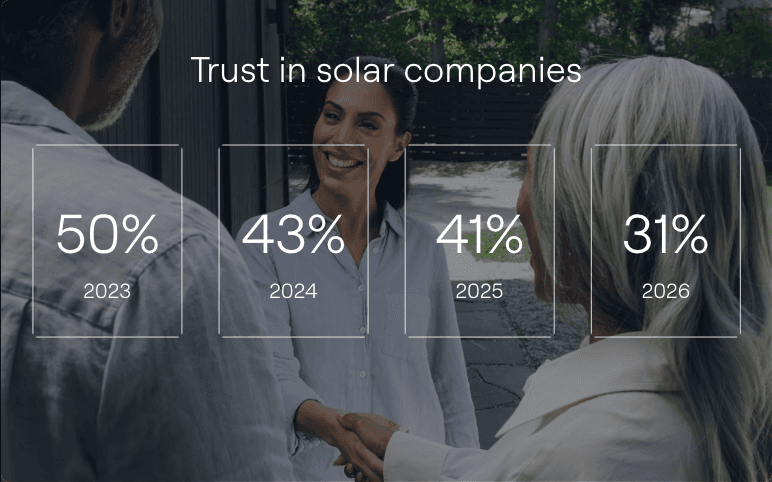
One big thing driving this mistrust is the fear of being scammed. We’ve all seen those ads that seem too good to be true: Free Solar! Limited Time Offer! BUY NOW!
How do you separate what’s real from what’s fantasy, and make sure you don’t get scammed? You’ve come to the right place.
In this piece, we’ll break down the most common scams, the red flags to watch for, and how to protect yourself.
In this article
- What are the most common solar scams?
- Red flags to watch for
- The real risks of falling for a scam
- How to protect yourself from solar scams
- Staying safe while going solar
- Frequently asked questions
What are the most common solar scams?
Here are a few of the most common solar scam examples to be aware of.
The “free solar panel” scam
This scam starts off with claims of free solar panels in exchange for your personal and private information. There have been a lot of policy changes (to say the least) over the past few years, and as a result, some companies are attempting to take advantage of the widespread confusion about what the government actually offers to homeowners.
The Department of Energy has made this scam especially simple to spot. Per their most recent release on the issue, they don’t offer any free solar panels — so anyone claiming to be federally affiliated telling you otherwise is wrong, and should be reported to the Federal Trade Commission (FTC) and the Consumer Financial Protection Bureau (CFPB).
Now, there are ways to finance solar panels with very little, or even zero, money down. With third-party ownership (you’ll hear installers call this “TPO”) you can lease your system or even purchase the electricity it produces at a discount (a power-purchase agreement or PPA) while someone else owns and maintains the system.
We have a couple other blogs to help show what’s possible:
What’s the difference between leasing and buying solar panels?
What’s the difference between a solar lease and a PPA?
Pressure to sign a “limited-time offer” for solar energy installations
False pressure and/or a demand for upfront, immediate payment are big red flags, according to the Federal Trade Commission (FTC). Seasoned, trustworthy installers know how complex the process can be, and respect if homeowners need extra time to explore other options or review contracts carefully.
The U.S. Department of the Treasury recommends:
- Exploring other options before committing
- Requesting an installer’s certifications and licensing to confirm they’re reputable
- Checking the installer’s history with state consumer agencies and licensing boards
- Verifying whether the cost savings you’ve seen in advertising are guaranteed
- Taking extra time to review your contract’s terms, ensuring you fully understand the scope of the agreement
If you’re already in the purchase process and you’re being pressured for a fast solar decision, whether you’re vetting installers or reviewing a contract, take a pause. You are the homeowner, and you are in complete control of the purchase process.
Exaggerated clean energy savings promises
False promises of bill elimination and other exaggerated energy savings opportunities are among the most common scams to watch for as you go through the solar investment process. They’re often used alongside other high-pressure sales tactics to get homeowners to commit to high-cost investments immediately, instead of taking the time to vet the installer and to review the contract.
Any installer worth their kilowatts should be able to show you detailed solar production estimates right in their proposal. They should also be able to calculate your savings based on an electric bill and your general usage (the more electric bills you’re able to provide, the better). This is where getting a few estimates is key, if one is much higher than the others, make sure their math is solid — and that they guarantee a certain amount of production in your contract.
Companies without proper licensing or credentials
While not a scam itself, companies attempting to work with clients without proper licensing or credentials are a red flag. Working with an unlicensed solar company to connect your home’s solar power leaves you wide open to financial and legal liability, safety hazards, and voided warranties.
Reputable vendors have no problem showing licensing and credentials prior to or during your solar project — so always be sure to request those before signing any agreements.
We understand that it can feel overwhelming trying to remember the signs and “red flags” associated with the most common solar scams. Just remember one critical rule: If you feel unsafe or if something feels “off” in your installer review process, you can always pause your solar project, delay your timeline until you have the information you need to proceed, or choose another vendor.
If you’ve already signed the contract with your current vendor and believe that they are attempting to scam you, request to pause the project and report your experience to the CFPB and FTC.
Red flags to watch for
There are several red flags to watch for in addition to the more specific scams noted above:
- Vendors requesting large upfront payments without presenting licensing information, an escrow process, or full quote and agreement may be attempting to overcharge or commit fraud. This is especially risky if the company is pressuring you to sign a limited-time offer or move forward without a clear understanding of who they are and what comes next.
- Refusal to provide written contracts or warranty terms. Reliable installers are used to providing full, specific proposals and contracts for interested clients, and should have no problem walking you through questions you may have. Additionally, they should have readily available information about warranties and exclusions.
- Seeking lots of personal info. If a company is trying to get excessive amounts of personal information from you online or on social media, they could be trying to get leads to sell or even trying to steal your identity. Asking for your email and address is one thing, asking for your SSN and mother’s maiden name? Red flag.
- Unsolicited door-to-door offers. While legitimate solar companies may choose to go door-to-door as part of their marketing strategy, many scammers do, too. If you are interested in an offer you’ve received as part of a solicitation campaign, we recommend doing independent research on the company before reaching out. You should also call the company and ensure that the person you spoke to at your door truly does work there. Getting solar from a door-to-door salesperson isn’t necessarily bad, you just need to do your homework.
- Overly aggressive timelines. Fast work isn’t always bad. However, an excessively fast timeline can be a red flag, leaving little room for proper contract review and due diligence. Salespeople could also hide behind a too-quick timeline to force the homeowner into voiding their right to cancel the transaction during the FTC’s three-day cooling off period. If you have a salesperson pressuring you for a decision on a quick timeline, take whatever time you need to review the contract and the vendor thoroughly. Reputable solar companies will not penalize you for doing this.
The real risks of falling for a scam
The risks of falling for a scam underscore the importance of doing your homework. Homeowners who engage with unscrupulous solar companies run the risk of serious financial losses and legal complications, as well as safety risks from the installation itself. There also may not be a way to recoup all or any portion of your solar investment.
How to protect yourself from solar scams
There are plenty of preventive actions homeowners can take to avoid falling victim to a solar scam. Here’s a quick step-by-step guide.
- Learn before you shop. Knowledge is power, especially in the solar space. Before you begin searching for vendors, take the time you need to fully understand tax credits, incentives, and solar pricing. That way, you’re already aware of what financing is reasonable and available before you speak to a salesperson.
- Get multiple quotes. Shop around before you make your decision, as this review process ensures you find the best possible deal and terms for your local area.
- Check licenses and credentials. Before signing any agreements, always verify that your solar vendor of choice is current and licensed with state licensing boards and NABCEP.
- Read contracts carefully. While this may seem obvious, its importance can’t be overstated. Always thoroughly review your contract and understand the proposed financing terms, cancellation clauses, and warranty language.
- Research the company. Before signing your contract, check reviews, Better Business Bureau (BBB) ratings, and lawsuits associated with your installer. This is another failsafe to ensure that the vendor you are working with is reliable, honest, and experienced.
- Use a vetted marketplace to find your next solar installer. Marketplaces like Aurora connect you with pre-screened, trustworthy installers .
Before you start vetting companies, see what 1,000+ homeowners actually think about the solar industry right now — no email, just two questions. Find yourself in the data →
Staying safe while going solar
The price of falling victim to a scam is too high to ignore. By spotting red flags early, you can protect your investment and interests.
If you’re looking for a solar company you can trust, visit Aurora’s vetted installer marketplace today. Every company has been vetted for certification and licensing and is ready to help you with your solar project.
Frequently asked questions
What key elements should I look for in a solar contract?
The key elements to look for in your solar contract include a clearly defined scope of work, a reasonable payment schedule that aligns with your previously provided scope, warranty terms, cancellation policies, and litigation instructions. These elements allow you to protect your interests, and have a full understanding of what you’re agreeing to and the cost and timeline you’re agreeing to maintain.
How can I confirm a solar installer’s licensing and insurance?
Start by requesting a copy of each from your installer. After you get them, search for your state’s contractor licensing board website and enter the provided license number. By doing this, you can see if they have any current disciplinary actions taken or any complaints associated with their workmanship.
Are “free solar panels” offers legitimate?
You have to examine free solar panel offers very, very carefully. When the offer is allegedly coming from the federal government that is a bright red flag. The Department of Energy was seeing this scam so frequently that they had to release literature stating that they are not providing free solar panels, nor do they plan to. If you’re being told that you could have free solar panels for your home, we recommend that you thoroughly vet the offer, installer, and any fine print around the financing or lease agreements that come with the claim.
That being said, there are third-party ownership options that require little or no money down that can be a great, inexpensive way to get solar on your roof.
Can I trust online reviews when choosing a solar company?
Online reviews are helpful resources for homeowners who are vetting a solar company, and they should be used alongside resources like the BBB. Be sure to look for patterns across platforms and be wary of overly generic or overly positive feedback.
How can a marketplace help protect me from scams?
Many marketplaces screen and verify installers based on client experiences, certification, and licensure, ensuring you have a pool of qualified solar companies in your area to choose from. Aurora, for example, routinely verifies vendors on the platform to ensure that you have the highest level of transparency and trust in your investment.