How many watts does a dehumidifier use?
A dehumidifier typically uses 300–700 watts, depending on its size and capacity. Read on for how to calculate your unit’s exact kWh usage and what it’s costing you.
If you’ve noticed your electricity bill creeping up in the summer, or year-round if you live in a humid climate, your dehumidifier could be playing a larger role than you think. Dehumidifiers are easy to overlook because they work quietly in the background, but they run for long stretches and can add to your home’s energy load.
Understanding how many watts your dehumidifier uses is a smart first step toward managing your home’s electricity costs. For homeowners considering solar, it’s also a useful data point when calculating your home’s total energy consumption and right-sizing a system.
In this article:
- How many watts does a dehumidifier use?
- Do dehumidifiers use a lot of electricity?
- Key terms you should know
- How to calculate dehumidifier energy consumption
- Factors that affect dehumidifier energy use
- Tips to reduce dehumidifier energy usage
- Take control of your home’s energy costs
- Frequently asked questions
Curious about your other appliances? Visit our Home Appliance Wattage Guide.
How many watts does a dehumidifier use?
Dehumidifier wattage varies primarily by size, which is rated in pints of moisture removed per day. Here’s a general breakdown:
| Dehumidifier size | Capacity | Typical wattage |
| Small/portable | 20–30 pints/day | 300–500 watts |
| Medium | 30–50 pints/day | 500–700 watts |
| Large/whole-home | 70+ pints/day | 700–1,000+ watts |
For context, most single-room or basement dehumidifiers sold for home use fall in the 30–50 pint range — so a wattage of roughly 500–700 watts is typical.
You can find your specific unit’s wattage listed on its label or in the product manual. If the label only shows amps and volts (which is common), use this formula to find wattage:
Volts × Amps = Watts
For example, a unit rated at 120V and 5A uses 600 watts.
Do dehumidifiers use a lot of electricity?
Compared to major appliances like air conditioning (3,000–5,000 watts) or electric dryers (5,000+ watts), a dehumidifier’s wattage is modest. But dehumidifiers often run 8–12 hours per day — or even continuously in very humid conditions — which adds up.
A 600-watt dehumidifier running 10 hours a day uses 6 kWh daily, or roughly 180 kWh per month. At the U.S. average electricity rate of about $0.19/kWh, that’s around $35/month — comparable to running a refrigerator.
So: not a lot per hour, but it can add up over long run times.
Key terms you should know
Watts (W) and Kilowatts (kW)
Watts measure the rate of electricity consumption. One kilowatt (kW) equals 1,000 watts.
Kilowatt-hours (kWh)
Kilowatt-hours measure how much electricity is actually consumed over time — it’s what your utility bills you for. Running a 600-watt (0.6 kW) dehumidifier for 10 hours uses 6 kWh. (Learn more about the difference between kW and kWh.)
Pints per day
This is the standard measure of a dehumidifier’s capacity — how many pints of moisture it can remove from the air in 24 hours. A higher pint rating generally means a more powerful (and higher-wattage) unit.
Integrated Energy Factor (IEF)
The IEF is an efficiency rating that measures how many liters of water a dehumidifier removes per kilowatt-hour of electricity used. A higher IEF means better efficiency — more moisture removed for less energy. The Department of Energy sets minimum IEF standards, and ENERGY STAR-certified models must exceed them by a certain amount.
How to calculate dehumidifier energy consumption
Once you know your dehumidifier’s wattage, it’s straightforward to estimate what it costs to run.
Daily kWh usage: Watts × Hours Used Per Day ÷ 1,000 = Daily kWh
Example: A 600-watt dehumidifier running 10 hours/day → 600 × 10 ÷ 1,000 = 6 kWh/day
Monthly cost: Daily kWh × 30 × Your Electricity Rate = Monthly Cost
Example: 6 kWh/day × 30 days × $0.19/kWh = ~$34.20/month
You can find your electricity rate on your utility bill, typically listed as cents per kWh. Rates vary significantly by state — Hawaii averages around $0.39/kWh while Louisiana averages around $0.11/kWh — so your actual cost may be higher or lower.
Factors that affect dehumidifier energy use
Size and capacity
Larger-capacity units pull more watts, but they’re also built to cover larger spaces more efficiently. Using an undersized unit in a very humid or large space can cause it to run continuously without ever reaching your target humidity, wasting energy. Matching your unit’s pint capacity to your space is key.
The EPA’s sizing guide recommends a 30-pint unit for moderately damp spaces up to 1,500 sq ft, and a 50-pint unit for wet conditions or spaces up to 2,500 sq ft.
Ambient humidity levels
The more moisture there is in the air, the harder and longer your dehumidifier has to run to hit your target humidity level. Homes in coastal or southern states typically see much higher dehumidifier run times than homes in drier climates.
Temperature
Dehumidifiers work less efficiently in cold temperatures. Most standard units slow down or stop removing moisture effectively below about 60°F, depending on the specific model. If you’re running a dehumidifier in an unheated basement during winter, look for a unit rated for low-temperature operation — otherwise your energy use may climb with little benefit.
Target humidity setting
The lower you set your target humidity, the harder your unit works. The EPA recommends keeping indoor humidity between 30% and 50%. Setting your dehumidifier to 45% rather than 35% can meaningfully reduce run time and energy consumption.
Energy efficiency rating
ENERGY STAR-certified dehumidifiers use less energy than standard models that meet minimum federal requirements. Over the life of the appliance, that adds up. The ENERGY STAR program maintains a list of certified dehumidifiers with their IEF ratings.
Tips to reduce dehumidifier energy usage
Set the right humidity target
Aim for 45–50% relative humidity. This is enough to prevent mold and dust mites without running your unit harder than necessary. Most dehumidifiers have a built-in humidistat — use it rather than leaving the unit running continuously.
Right-size for your space
If your unit is too small for the area you’re dehumidifying, it will run nonstop. If it’s too large, it may short-cycle. Either way, you lose efficiency. Use the EPA’s sizing guidelines to find the right capacity for your space.
Run during off-peak hours
Many utilities charge lower rates during off-peak hours, typically overnight and early morning. If your unit has a timer or smart controls, schedule it to run during these windows to lower your energy costs. Of course, this can be tough, since the most humid times of day are often in the afternoon, so this can only help so much.
Clean the filter regularly
A clogged filter forces the unit to work harder and can reduce its effectiveness. Check your filter monthly and clean or replace it per the manufacturer’s recommendation — typically every few weeks during heavy use.
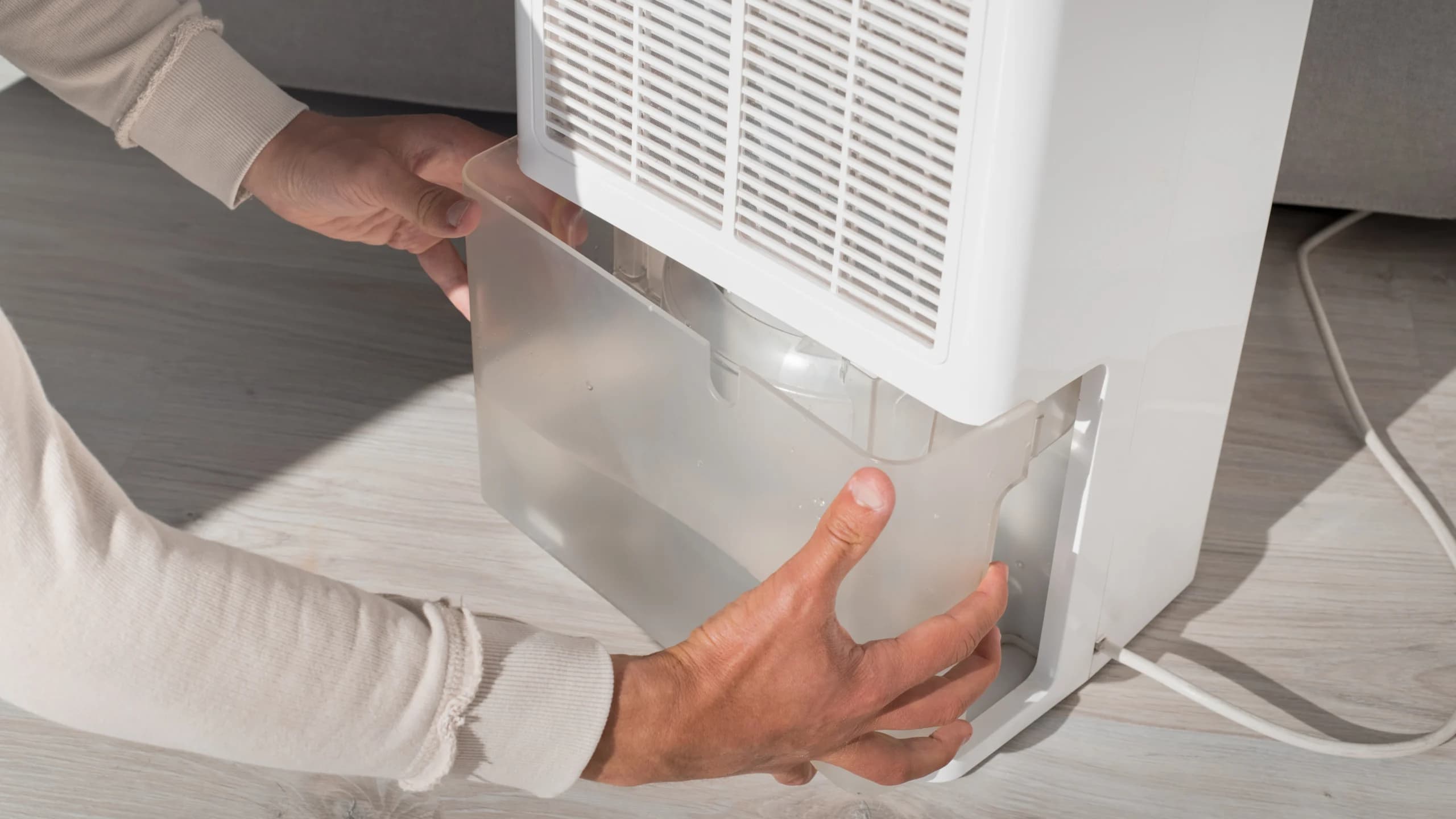
Empty the water tank promptly (or use a drain hose)
Most dehumidifiers automatically shut off when the tank fills. If the tank fills overnight and you don’t empty it until evening, your unit sat idle for most of the day. Using a gravity drain hose or a unit with a built-in pump lets it run continuously without interruption.
Seal the space
If the area you’re dehumidifying has significant air leaks — gaps around windows, doors, or pipes — humid air from outside is constantly replenishing what your unit removes. Sealing those leaks reduces the workload on your dehumidifier (and your HVAC system). The DOE’s air sealing guide is a good starting point.
Take control of your home’s energy costs
A dehumidifier is just one piece of your home’s overall energy picture. Once you understand the consumption of your major appliances — from air conditioning to refrigeration to dehumidification — you’re better positioned to evaluate where solar could make the biggest dent in your bills.

Compare quotes from multiple vetted solar installers and see how a battery fits into your home’s energy picture, all in one place.
Frequently asked questions
Q: Do dehumidifiers use a lot of electricity?
Relative to large appliances like central AC or electric dryers, no — dehumidifiers typically use 300–700 watts, which is modest. But because they often run for many hours per day, monthly costs can add up to $20–40 or more depending on your unit’s wattage, run time, and local electricity rate.
Q: How much does it cost to run a dehumidifier per month?
It depends on your unit’s wattage and how long it runs. A 600-watt dehumidifier running 10 hours a day uses about 6 kWh daily. At the U.S. average rate of $0.19/kWh, that’s roughly $35/month. You can calculate your specific cost using the formula: Watts × Daily Hours ÷ 1,000 × Rate × 30.
Q: How many hours a day should a dehumidifier run?
In moderately humid conditions, 8–12 hours per day is typical. In very humid climates or during summer months, some units run nearly continuously. Using a humidistat to set a target humidity level (45–50%) rather than running the unit on a fixed schedule can significantly reduce run time and energy use.
Q: Is it cheaper to run a dehumidifier or an air conditioner?
Almost always cheaper to run a dehumidifier. A window AC unit uses 500–1,500 watts; central air uses 3,000–5,000 watts. A dehumidifier at 300–700 watts uses a fraction of that. That said, in humid climates, both often run simultaneously, so total costs climb.
Q: How many solar panels does it take to run a dehumidifier?
Assuming a 400-watt solar panel produces roughly 2 kWh per day, a 600-watt dehumidifier running 10 hours a day (6 kWh) would require about 3 solar panels to fully offset. An Aurora solar advisor can give you a precise estimate based on your home, location, and total energy usage.
Curious about your other appliances? Visit our Home Appliance Wattage Guide.