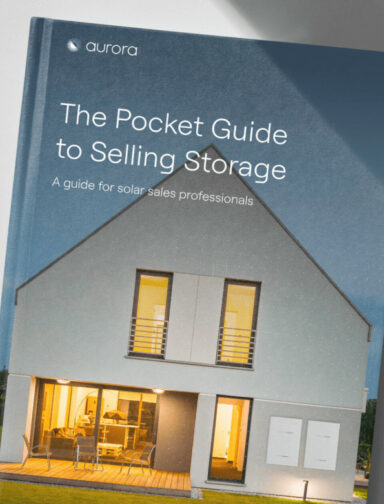
Not long ago, battery storage was a premium add-on. A few markets were early adopters: California, driven by NEM 3.0 and the economics of time-of-use rates; parts of the South and Gulf Coast, driven by post-hurricane resilience awareness. Everywhere else, storage was an option on the menu, not a core part of the pitch.
That’s changed. Quickly.
The 2026 Aurora Solar Snapshot data makes clear that storage has moved from add-on to foundational — and for solar sales teams, that shift changes the entire structure of a conversation with a homeowner.
Attachment rates are rising, fast
In 2025, 57% of salespeople said at least 25% of their projects included storage. For 2026, that number rises to 65%. And at the high end of the market: 31% of salespeople expect storage on at least 75% of their projects, up from 27% the year before.
These aren’t incremental gains. The trajectory is steep, and it’s showing up in real project data, not just optimistic forecasts. The market is moving toward solar-plus-storage as the standard configuration, not the premium one.
It’s not just new installs
Here’s the number that often surprises people: 72% of salespeople say at least some of their storage projects are retrofits or add-ons to existing systems. And 47% say they’re selling at least some battery-only systems with no solar at all.
Those two data points together describe a genuinely new market opportunity. Solar salespeople aren’t just selling to homeowners who want solar. They have a growing base of installed solar customers who bought their system before batteries were standard — and who now have utility bills, grid anxiety, or time-of-use rate structures that make storage the next logical conversation. The retrofit market is real, it’s active, and it rewards teams that have thought through how to model and pitch storage-only and add-on configurations.
Only 18% of salespeople report doing zero retrofit storage installs. That’s a small minority. The rest are in it, to varying degrees.
| 💡 Model battery add-ons and PV retrofits: Aurora’s purpose-built retrofit workflow lets you easily model and quote storage on existing solar systems, without starting from scratch. Learn how to model PV and battery add-on projects. |
What’s actually motivating homeowners
When salespeople were asked about the primary motivation for homeowner storage purchases, the answer wasn’t subtle: backup power and outage protection came in at 56%. Energy independence was second at 21%. Maximizing bill savings was third at 19%.
The grid reliability story is real and it’s resonating. US customers experienced an average of 11 hours of power outages in 2024, nearly double the rate of a decade earlier. Homeowners feel that. A rep who can connect the storage conversation to a real, recent local outage — a storm, a heat wave, a grid event — is speaking directly to something the homeowner has probably experienced themselves.
The bill savings story matters too, particularly in markets like California where NEM 3.0 has reshaped the economic case for solar. In those markets, storage isn’t just about resilience — it’s about maximizing self-consumption and avoiding peak export losses. A one-size-fits-all storage pitch misses that regional nuance.
Full home backup vs. partial: knowing what to recommend
The survey asked salespeople about the mix of storage configurations they install. On average, full home backup represents about 51% of storage installs, while partial home backup with self-consumption averages around 34%. Energy arbitrage configurations, both partial and standalone, round out the rest.
When homeowners want partial backup, they typically want 15-30% reserve (29% of salespeople said this is the most common range), though 21% say they regularly see homeowners asking for over 60% reserve. Understanding what a homeowner actually wants to protect — the refrigerator and a few lights, vs. the whole house — changes the system size, the cost, and the conversation.
The complexity here is an opportunity, not a barrier. A rep who can model multiple scenarios — backup-only vs. backup-plus-self-consumption vs. full home — and explain the tradeoffs in plain language is offering something most competitors can’t.
| 💡 Advanced solar + storage modeling: Aurora’s battery modeling tools let you configure backup scenarios, compare self-consumption vs. full backup, and show homeowners accurate bill savings and energy previews — all within the proposal. Learn how to add battery storage to your proposal. |
The modeling gap
28% of salespeople said storage design practices was the topic they most wish they had more training on. That’s the second-highest training gap identified in the survey, just behind policy and incentive changes. It makes sense: storage design involves considerations that pure solar sales didn’t — battery sizing, load selection, backup duration, use case prioritization. These are learnable skills, but they require the right tools and the right education.
Teams that invest in storage training now are positioning themselves for the growth phase of this market — not catching up to it.
Read the rest of the series here:
- Solar financing in 2026: more options, more closes
- Solar competition is up — and trust is winning
- Why solar deals stall at the close — and how top reps fix it
This is the fourth article in Aurora’s 2026 Solar Snapshot series. Next up: The solar sale is expanding beyond panels. What the data says about the home energy opportunity and how salespeople are evolving into whole-home advisors.