
Bidirectional charging: Can your EV power your home?
Bidirectional charging lets energy flow both ways between your EV and your home — so your car can act as a giant backup battery when the grid goes down. Here’s how it works, which vehicles support it, and what it takes to set up.
Most people think of an EV as something you plug in. Bidirectional charging flips that: your car becomes something you can also plug things into, including your entire house.
The technology has moved fast. A growing number of EVs now support some form of bidirectional charging, and for homeowners who already own a compatible vehicle, the idea of using their car’s battery as home backup power, without buying a separate storage system, is compelling. A typical EV stores 50–100 kWh of energy, enough to power an average home for 2–4 days at normal whole-home use, or more if you conserve electricity and only power the essentials. In practice you won’t get the full battery: Most systems hold back a reserve, and there are conversion losses, too.
Here’s what bidirectional charging actually means, which vehicles support it, what you need to make it work, and what to think through before going down this path.
In this article:
- What is bidirectional charging?
- The three types: V2L, V2H, and V2G
- Which EVs support bidirectional charging?
- What does it take to set up V2H at home?
- How it compares to a dedicated home battery
- Bidirectional charging and solar
- The trade-offs
- Frequently asked questions
What is bidirectional charging?
Standard EV charging is one-directional: electricity flows from the grid (or your solar panels) into the car. Bidirectional charging means electricity can also flow the other direction: from your car’s battery back out to power something else.
That “something else” can be a single device, your whole house, or the electric grid itself. Which one depends on the type of bidirectional capability your car has, and what equipment you have installed at home.
The technology that makes this possible is built into the car’s onboard electronics, specifically the inverter and power management system. Not every EV has it, which is why it’s important to do your research first.
The three types: V2L, V2H, and V2G
Bidirectional charging covers three distinct use cases:
V2L — Vehicle to Load
V2L means your car can power devices directly. Think camping appliances, power tools, a TV at a tailgate, or keeping a refrigerator running during a short outage, all plugged directly into an outlet on or in the car. No special home equipment required.
Many current EVs already offer V2L, including the Hyundai Ioniq 5 and 6, Kia EV6 and EV9, and others. It’s the most accessible form of bidirectional capability and requires nothing beyond the car itself.
V2H — Vehicle to Home
V2H is what most homeowners mean when they talk about powering their house from their car. Your EV connects through a bidirectional charger to your home’s electrical panel, and the car’s battery powers your home’s circuits — lights, appliances, HVAC, whatever you’ve configured — just like a dedicated home battery would.
This requires a bidirectional charger (different from a standard Level 2 charger), a transfer switch or critical-loads panel, and a compatible vehicle. But when it works, you have 50–100 kWh of backup capacity sitting in your driveway, more than what most home batteries hold.
V2G — Vehicle to Grid
V2G goes one step further: Your car feeds energy not just to your home, but back to the electric grid. This is the foundation of EV participation in virtual power plant programs, where utilities can draw on the combined capacity of thousands of plugged-in EVs during peak demand, and compensate owners in return. V2G is still in earlier-stage rollout compared to V2H, with pilot programs expanding across the U.S. in 2025–2026.
Which EVs support bidirectional charging?
Fewer EVs than you might expect support bidirectional charging. And the list is constantly changing, so please take this as a guide and do your own research, and get out there and talk to people about it! But one automaker dominates, a handful of others have options right now, and a much larger group has the hardware without the software.
Available today
- GM — by far the widest lineup, and all of it runs on one system: the GM Energy PowerShift charger plus a V2H Enablement Kit, delivering 9.6 kW to the home. Covers the Chevrolet Silverado EV, Blazer EV and Equinox EV; GMC Sierra EV and Hummer EV; and the Cadillac Lyriq, Optiq, Vistiq, Escalade IQ and Celestiq. The 2027 Bolt EV will be the cheapest way into V2H when it is available.
- Tesla Cybertruck — Powershare, 11.5 kW, through a Universal Wall Connector and Powershare Gateway.
- Kia EV9 — the first Hyundai-group vehicle enabled in the US, via a Wallbox Quasar 2. Initially California, Texas, Florida, New York, Washington, New Jersey and Illinois.
- Volvo EX90 and Polestar 3 — both through dcbel’s Ara home energy station, and both limited to the 400V versions of the car. Polestar started in California with other states to follow.
Hardware-ready, but not switched on
These cars are built for it; the manufacturer hasn’t enabled it.
- Hyundai Ioniq 5, 6 and 9 — Hyundai has said the Ioniq 9 goes first. No date for the others.
- Kia EV6 — announced in December 2025 as coming “in the near term.”
- Genesis GV60 and Electrified GV70 — same platform as the Hyundai and Kia cars, but not named in the group’s US rollout.
- Lucid Air and Gravity — bidirectional hardware in every car; V2H has slipped past its original target.
If you’re shopping specifically for backup power, this second group is more of a question mark. Mercedes and Rivian have both announced bidirectional systems, but for markets and dates that don’t yet include the US.
And, let’s get to some notes…
A note on Tesla: Besides the Cybertruck, Tesla’s passenger vehicles don’t support V2H. Powershare is Cybertruck-only, and the Powerwall is Tesla’s answer for the rest of the lineup. Some 2026 Model Y trims offer a small V2L outlet adapter, good for tools and appliances, but it won’t power your house.
A note on Ford: The F-150 Lightning was arguably the most exciting V2H vehicle in the US, and its 9.6 kW home backup still works for existing owners. But production ended in December 2025, and the Charge Station Pro the system depends on is no longer sold, so it isn’t a path you can start from scratch today.
A note on the Nissan Leaf: The Leaf is often listed as V2H-capable, and technically the CHAdeMO cars are; Nissan pioneered vehicle-to-home in Japan, where “LEAF to Home” units have been sold since 2012. But there has never been a residential V2H product for US Leaf owners. The redesigned 2026 Leaf settles the question by dropping CHAdeMO for NACS, offering only a small V2L outlet.
Enablement dates, in particular, change often, so check the manufacturer’s own page before you buy, their sites stay more current than roundups (including this one).
What does it take to set up V2H at home?
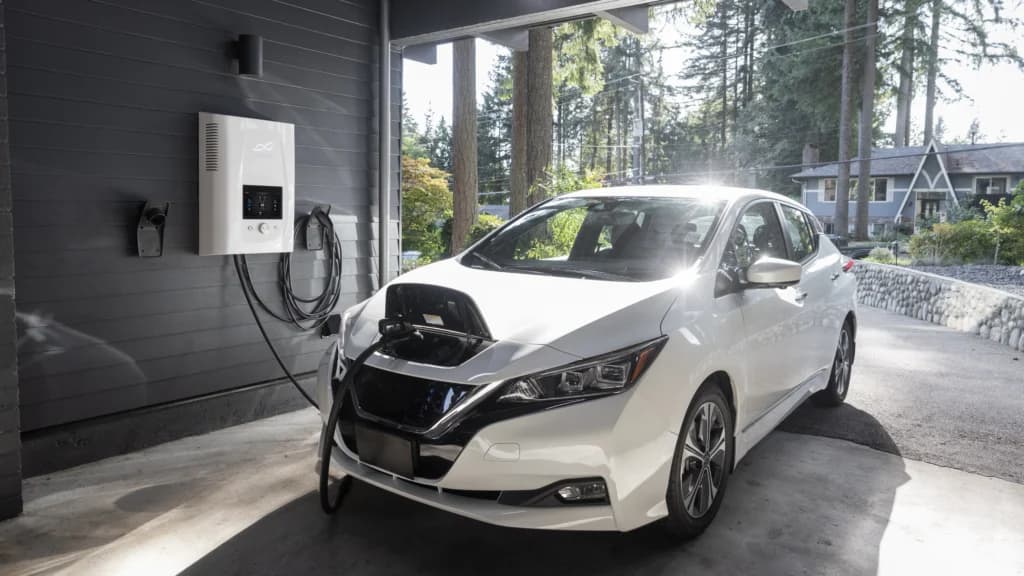
Owning a compatible EV is the starting point, but it’s not the whole picture. Setting up V2H requires dedicated equipment and professional installation. Here’s what’s involved:
A bidirectional charger. This is not the same as a standard Level 2 home charger. Bidirectional chargers manage the two-way flow of electricity and can cost anywhere from about $2,000–$9,000 for the hardware alone. Some automakers offer their own systems (Tesla Powershare Gateway, GM Energy home bundle); others rely on third-party hardware.
A gateway that can island your home. To power your house safely, the system has to disconnect from the grid during an outage. Almost every V2H product builds this in: GM’s Home Hub, Tesla’s Powershare Gateway, and Ford’s Home Integration System all handle the transfer themselves, so it isn’t a separate purchase. What you do still choose is scope: whole-home backup, or a critical-loads subpanel covering selected circuits.
Electrician labor. This is not a DIY installation. Professional installation typically runs $1,500–$4,000, but we’ve seen quotes above $7,000 in some markets. Some homes may require a panel upgrade if they don’t already have 200-amp service.
Total installed cost: Most V2H systems land in the $5,500–$12,000 range depending on hardware brand, home electrical conditions, and whether the automaker’s own solution is available for your vehicle. Most homeowners can expect to pay about $7,000–$9,000 when it’s all said and done.
How it compares to a dedicated home battery
If you already own a V2H-compatible EV, the comparison looks different than if you’re starting from scratch.
| EV with V2H | Dedicated home battery (e.g., Powerwall 3) | |
| Installed hardware cost | $5,500–$12,000 (plus, you know, the actual car) | ~$13,000–$15,000 |
| Always available? | Only when parked and plugged in | Yes, 24/7 |
| VPP/grid program participation | V2G (emerging) | Yes, widely available |
| Best for | Homeowners who already own a compatible EV | Homeowners who want guaranteed, always-on backup |
The math changes significantly if you already own a compatible EV. You’re not paying for storage capacity you don’t have, you’re adding the hardware to use capacity that’s already in your driveway. For those homeowners, V2H can be meaningfully cheaper than a dedicated battery.
The bottomline trade-off is that a dedicated battery is always there. Your EV isn’t. If it’s parked elsewhere, the grid goes down, or the battery is depleted from driving, your backup is unavailable. If you have two vehicles or a predictable at-home schedule, this might not be a problem. But for others, it’s a real limitation.
Bidirectional charging and solar
V2H and solar work well together, and the combination addresses each system’s weakness.
Solar panels generate the most power during midday, but most homes need power in the morning and evening. A bidirectional EV solves this: Your panels charge the car during the day, and the car powers the home (or offsets grid usage) when the sun goes down. This is essentially the same logic as solar plus a home battery, the car just happens to be the storage device.
Will your solar actually run during an outage?
Most articles skip this, but conventional grid-tied solar systems shut down the moment the grid goes down, so that line workers aren’t exposed to power your panels are pushing back out. Unless something supplies a grid-forming reference, your system sits idle in exactly the situation you bought it for.
Solar batteries are made for this situation, and “island” the home in these cases, switching to battery, and charging during the day. Some V2H systems can do something similar and keep your panels producing inside the island. Ford’s Sunrun Home Integration System and the GM Energy Inverter (which ships with a solar disconnect switch and is designed to manage multiple off-grid sources) are both built for it. A bare bidirectional charger paired with a transfer switch generally is not. And if you already have an AC-coupled string inverter, it has to be curtailed by frequency shift for any of this to work.
Ask any installer quoting a V2H system two questions:
- Will my panels run during an outage?
- What does it cost to make that true?
One smaller mechanical note: A battery can’t charge and discharge at the same time. In practice, solar serves the house first and surplus goes to the car, so “panels charge the car while the car powers the house” is the idea, but not the exact way it happens.
The pairing is especially compelling in states with time-of-use (TOU) electricity rates, where grid power is most expensive in the late afternoon and evening. Solar charges the EV during cheap midday hours; the EV discharges during expensive peak hours. The economics can be meaningful.
For V2G participants, the connection goes further: Solar-charged EVs that feed energy back to the grid during peak demand can earn compensation through virtual power plant programs. Check out our blog on what virtual power plants are and how they work to learn more.
If you’re interested in how battery storage fits into your solar system more broadly, that’s a useful place to start before deciding between an EV-based V2H setup and a dedicated battery.
One more thing: Most OEM backup systems, including GM’s and Tesla’s, are designed to discharge only during an outage, not on a daily schedule. So, if you’re looking to take advantage of TOU rates, confirm your system supports it before committing.
The trade-offs
Bidirectional charging is genuinely useful, but a few things are worth being clear-eyed about before deciding to pursue it.
Your EV has to be home and plugged in. This sounds obvious, but it’s the most important limitation. If your car is at work or elsewhere when the grid fails, you have no backup. Homeowners who commute daily or share a single EV may find this unpredictability hard to plan around.
EV batteries degrade with cycling too. Just like a home battery, more charge and discharge cycles mean faster degradation over time. V2H adds cycles beyond what driving alone requires. Some automakers have begun offering warranty assurances for bidirectional use — worth confirming for your specific vehicle before enabling V2H.
The ecosystem is still maturing. Automaker V2H solutions vary significantly in polish and reliability. Some are well-integrated; others require third-party workarounds. The hardware and software will improve, but as of 2026, this is still earlier-stage technology compared to a dedicated home battery from a major manufacturer.
Software and utility compatibility. V2G (grid participation) requires your utility to support it. Not all do yet, though the list is growing. For V2H (home backup only), utility compatibility isn’t required, but local permit requirements still apply.
Want to see how a traditional solar battery can help you through a power outage? Play Blackout Battle!
The bottom line
Bidirectional charging is one of the most significant developments in home energy management in years — and for EV owners with compatible vehicles, it opens up backup power options that previously required a separate battery system.
If you own a V2H-capable EV today, it’s worth exploring whether adding a bidirectional charger and transfer switch makes financial sense for your home. The upfront cost is real, but the effective cost per kWh of backup capacity can be substantially lower than a dedicated battery when you already have the storage sitting in your garage.
If you’re shopping for a new EV and backup power matters to you, V2H capability is now a worthwhile item on your checklist alongside range and charge speed.
See how solar, storage, and smart home energy work together for your home, without giving your contact info — get an estimate in minutes.
Frequently asked questions
Q: What is a bidirectional EV charger?
A bidirectional EV charger allows electricity to flow in both directions — from the grid (or solar panels) into your car, and from your car’s battery back out to power your home or the grid. Standard Level 2 chargers only charge the car; bidirectional chargers enable vehicle-to-home (V2H) and vehicle-to-grid (V2G) capability.
Q: Which EVs support bidirectional charging?
In the U.S. today, GM has the widest lineup — ten models across Chevrolet, GMC and Cadillac, all running on one GM Energy system. Beyond that: the Tesla Cybertruck via Powershare, the Kia EV9 via a Wallbox Quasar 2 in select states, and the Volvo EX90 and Polestar 3 through dcbel hardware, both limited to the 400V versions. A larger group has the hardware but hasn’t been switched on by the manufacturer, including Hyundai’s Ioniq 5, 6 and 9, the Kia EV6, the Genesis GV60 and Electrified GV70, and Lucid’s Air and Gravity. Most EVs on the road are still one-directional, and enablement dates shift often, check the automaker’s page (and talk to someone!) before buying a car for backup power.
Q: How long can an EV power a house during an outage?
It depends on your battery and what you’re running. Most V2H systems hold back a reserve, GM’s default is 20%, and conversion costs another 10%, so a 75 kWh pack realistically delivers around 50 kWh from a full charge, less if the outage catches you at not a full charge. If you manage your usage (fridge, lights, Wi-Fi, phones) you can use 2–3 kWh/day; including a furnace blower or well pump runs 8–12. That puts most households in the 4–7-day range, less if you’re running central air.
With solar recharging the car, a well-configured system can stretch an outage from days into weeks, and in summer, in the right climate, approach self-sufficiency. But only if your PV is set up to run islanded, and only while daily production exceeds daily load. Modeling of real Texas homes found PV-assisted backup lasting anywhere from under a day to several weeks depending on season and load.
Q: How much does a bidirectional EV charger cost to install?
A complete V2H system — bidirectional charger, gateway and electrician labor — typically runs $5,500–$12,000 installed, with most homeowners landing around $7,000–$9,000. Hardware alone ranges from roughly $2,000 to $9,000: Tesla’s Powershare bundle sits at the low end, GM Energy’s V2H bundle near the top. Labor adds $1,500–$4,000, more if your panel needs work. One thing to know: there’s no longer a federal tax credit for this. The 30% residential clean energy credit ended for anything installed after December 31, 2025, and the $1,000 home-charger credit expired June 30, 2026.
Q: Is bidirectional charging bad for my EV battery?
It adds cycles. Every time the car discharges to power your home and then recharges, that counts as a charge cycle — which contributes to gradual battery degradation over time, just as it does for a dedicated home battery. The impact depends on how frequently you use V2H. Some automakers have begun offering specific warranty terms for bidirectional use; check your vehicle’s documentation before enabling V2H.
Q: What’s the difference between V2L, V2H, and V2G?
V2L (vehicle-to-load) powers devices directly from the car — no special home equipment needed. V2H (vehicle-to-home) feeds your car’s energy through your home’s electrical panel to power your house circuits, requiring a bidirectional charger and transfer switch. V2G (vehicle-to-grid) sends energy from your car back to the electric grid, enabling participation in utility programs and virtual power plants.