How many watts do holiday lights use? (LED vs. incandescent, 2026)
The kids are back in school, pumpkin spice has entered every conceivable food item, it can only mean one thing: You’ll start seeing holiday decorations at the store in the next couple weeks.
Whether you’re Clark Griswold, or more Grinch vibes, it can help to know what you’re doing to your electric bill before you get up on that ladder and string the lights. The good news is that if your display is within reason, it shouldn’t spike your bill too much. In fact, it’s really the type of bulb that matters most: a 100-bulb LED string uses about 5–10 watts, while a comparable incandescent string uses about 40 watts.
Curious how much your other appliances add to your bill? Visit our Home Appliance Wattage Guide.
In this article:
- LED vs. incandescent
- Watts by light type
- How to calculate your holiday lighting cost
- Wattage table: common holiday displays
- Alternative lights: solar, battery, and projection
- Tips to lower holiday lighting costs
- Frequently asked questions
LED vs. incandescent
We’ve already fought the incandescent vs. fluorescent vs. LED battle in offices and inside our homes. Yes, even as passionate energy conservationists, we appreciate the warmer, hazier glow of the incandescent bulbs of our sepia-toned memories. So, no judgement here if you choose the incandescent route (if you can find them!).
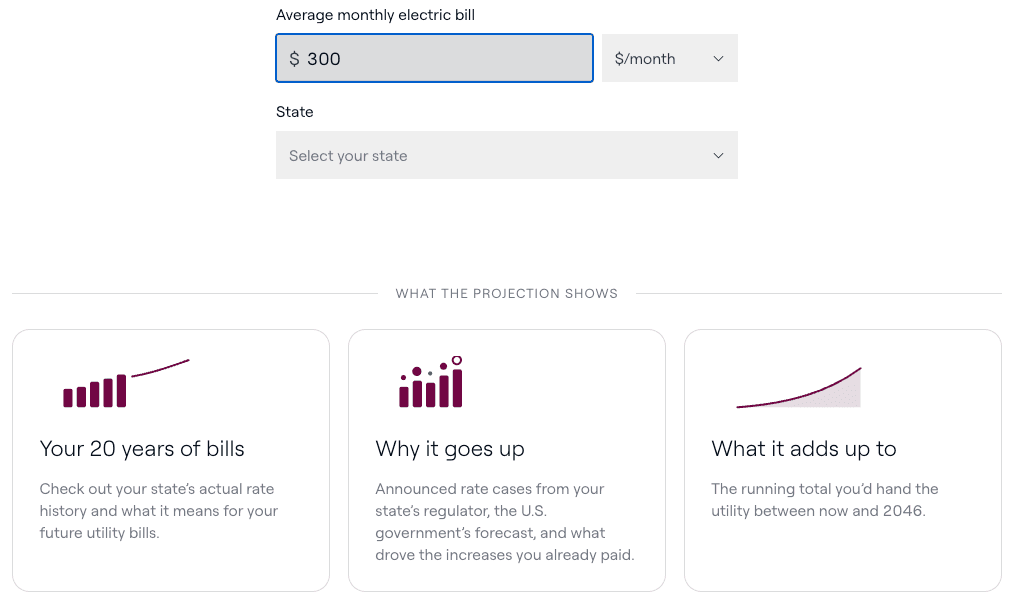
Holiday lights are just a minor part of the puzzle. See what your electric bill could look like over the next 20 years, with just your ZIP code, using our Electric Bill Projection tool.
But, there’s no arguing that LED displays have a certain je ne sais quoi that only lights with thousands of possibilities, that cost pennies to operate, can deliver.
That’s right, LED holiday lights use about 70–90% less electricity than equivalent incandescent bulbs.
- 100-bulb incandescent string: ~40 watts
- 100-bulb LED string: ~5–10 watts
Of course, one string is never enough. If you’re looking to deck out a 6-foot bush or shrub, you’re probably looking at 600 bulbs:
- 600 incandescent bulbs: ~240 watts
- 600 LED bulbs: ~60 watts
If you really want to get nuts, a full roofline display of about 500 feet, and upgrading to C9 bulbs (see below):
- 500 incandescent C9s: ~3,500 watts
- 500 LED C9s: ~480 watts
Now we’re getting into numbers where the type of bulb really matters. Even given the higher upfront cost, LED bulbs usually come out ahead after just a couple years.
How many watts by light type
Let’s take a look at the different types of bulbs and how they factor into the energy equation.
Mini string lights (the standard)
When we picture holiday lights, we’re mostly thinking of the typical, small strings. Called mini string lights in the business, they’re the most common type, used for trees, railings, wreaths, and bushes.
- Incandescent mini lights: ~40 watts per 100-bulb string
- LED mini lights: ~5–10 watts per 100-bulb string
One thing to keep in mind here: Because they use so little energy, you can string together more LED light strings than incandescent. Important if you’re Griswalding this thing.
C7 and C9 bulbs (rooflines and large displays)
We didn’t know this before we started researching this blog, but C7 and C9 bulbs are the large, classic bulbs used for rooflines, gutters, and outdoor outlines. As you might imagine, since the bulbs are bigger and brighter, the wattage difference is exaggerated, too.
Per-bulb wattage:
| Bulb type | Incandescent | LED |
| C7 | ~5 watts | ~0.5 watts |
| C9 | ~7 watts | ~0.8–1 watt |
Let’s say you’re looking at 300 feet of C9s at 12-inch spacing. That’s, obviously, 300 bulbs. With LEDs it’s still a scant 300 watts or so. Incandescents? 2,100 watts, also known as 2.1 kilowatts. This is so much that it might require multiple outlets to avoid tripping circuit breakers.
Icicle lights
You either love them or hate them. (Editor’s note: HATE. Not sorry.) For energy purposes, they’re very similar to mini strings. Incandescent icicle lights draw ~40–50 watts per 100-bulb string, while LED icicle lights draw ~5–7 watts.
Rope lights
With rope lights, we measure wattage per foot rather than per bulb.
- Incandescent rope lights: ~3–5 watts per foot
- LED rope lights: ~0.5–1 watt per foot
This means a 25-foot rope light run will be about ~75–125 watts for incandescent vs. ~13–25 watts for LED.
How to calculate your holiday lighting cost
All right, now that we’ve got the basics down, how much will your individual display cost? Here’s a checklist to help:
- Find the total wattage of your display: How many strings X wattage per string (wattage is listed on the packaging or UL tag)
- Convert to kilowatts: Total watts ÷ 1,000 = kW
- Get kilowatt hours per day: Multiply the kilowatts by the number of hours you’ll be displaying per day
- Multiply by days you plan to run the display
- Multiply by your electricity rate: Find it on your utility bill; the national average is ~$0.18/kWh as of September 2026 (up 5% over last year!)
Let’s look at a fairly reasonable example. You want a tasteful display of 5,000 LED lights, each string drawing 10 watts. That’s 500 watts total, running a modest 6 hours per day for 31 days in December:
- 500W ÷ 1,000 = 0.5 kW
- 0.5 kW × 6 hrs = 3 kWh/day
- 3 kWh × 31 days = 93 kWh for December
- 93 kWh × $0.18 = $16.74 added to your December bill
Not too bad, right? Certainly worth it for all the joy you’re spreading.
Wattage table: common holiday display scenarios
Now let’s look at some common, and not so common holiday cheer scenarios. All cost estimates assume the display is on for 6 hours/day for 31 days in December at $0.18/kWh.
| Display element | Incandescent watts | Incandescent Dec cost | LED watts | LED Dec cost |
| Kinarah (7 C9 lights) | 49W | ~$1.65 | 7W | ~$0.25 |
| Menorah (9 C9 lights) | 63W | ~$2.10 | 9W | ~$0.30 |
| Small decoration/figure (100 lights) | 40W | ~$1.35 | 10W | ~$0.35 |
| Medium decoration/figure (250 lights) | 100W | ~$3.35 | 25W | ~$0.85 |
| Small tree/bush (300 lights) | 120W | ~$4.00 | 30W | ~$1.00 |
| Medium tree (500 lights) | 200W | ~$6.70 | 50W | ~$1.70 |
| Large tree (1,500 lights) | 600W | ~$20.10 | 150W | ~$5.00 |
| 500-ft roof (500 C9 bulbs) | 3,500W | ~$117.20 | 480W | ~$16.10 |
| Full display total | 4,623W | ~$154.80 | 754W | ~$25.25 |
Sources: ElectricAdvisors, using EIA national average rate ($0.18/kWh as of September 2026)
But, what if you want the full Griswold. As you likely know, that would be 25,000 incandescent Italian twinkle lights.
| Full Griswold (25,000 C9 lights) | 175,000W | ~$5,860 |
That’s 250 strings of 100 bulbs each, using about 700 watts per string. Unfortunately from the Griswolds’ electric bill, LED lights weren’t a thing back then. And, 175,000 watts at 120 volts is… problematic. Still? Worth it.
Alternative lights: solar, battery, and projection
Let’s take a look at some alternative light sources, as well.
Solar-powered holiday lights
Yes, of course a solar site would be plugging (pun intended) solar lights. They have some advantages, like drawing zero electricity from the grid. But, they also have some drawbacks: If you don’t get a good charge during the day, your display won’t make it through the night (or turn on at all).
Battery-powered holiday lights
Ah, maybe a step up from solar lights, battery-powered lights have some real advantages. They also draw no electricity from the grid. But, again, runtime can be a bit dicey. It depends on many factors including battery quality and even temperature. They can save you from the rat’s nest of extension cords, though.
Projection lights
One type of light that’s been gaining traction in the last few years is the projection-type display, where you shine a light on your house and it has all sorts of wonderful holiday scenes. A single projector typically uses ~5–6 watts, much lower than string displays. That means if you run it 6 hours per day in December, the added cost to your electric bill could be under $1. Not bad.
Tips to lower holiday lighting costs
How can you have that holiday cheer and keep costs down? Here are some tips.
Switch to LED: This is the single most important thing you can do to save energy. Replacing incandescent string with LEDs pays for itself in energy savings in 1–2 seasons for the extra festive among us.
Use a timer: There’s a reason we chose 6 hours of runtime. Running lights 6 hours/day instead of all night cuts costs significantly. Many LED string sets come with built-in timers, and plug-in timers are inexpensive additions for older sets.
Unplug when away: Lights left plugged in but “off” can still draw small amounts of power.
Use extension cords through obstructions, not light strings: If you’re routing around a corner or through a non-visible area, use an extension cord rather than wasting bulbs on a stretch no one sees.
Consider solar or battery for accent displays: Smaller accent pieces (potted plants, pathway markers, window frames) are great candidates for solar or battery lights.
Taking a step back, unless you’re a power displayer, your holiday display isn’t going to break the bank. It’s certainly minor when compared to things like heating and cooling, hot water heaters, and those always-on appliances. But, anything worth doing is worth doing in an energy-efficient way, so LEDs are the way to go: they offer a wider range of options, use far less electricity, and last for years.
Take control of your energy costs
Thinking about your December electric bill? How about the next 20 years? See what your bill could look like in the future, and what you can do to cut your electricity costs, with our Bill Projector.
Frequently asked questions
How many watts do LED Christmas lights use?
A 100-bulb LED string typically uses 5–10 watts, depending on bulb size and manufacturer. LED C9 bulbs use about 0.8–1 watt each; LED C7 bulbs about 0.5 watts each.
How many watts do incandescent Christmas lights use?
A 100-bulb incandescent mini-light string uses about 40 watts. Incandescent C7 bulbs use about 5 watts each; C9 bulbs about 7 watts each. A 500-bulb C9 roofline display can draw 3,500 watts, which is more than most household circuits can handle from a single outlet.
How much do holiday lights add to my electric bill?
It depends heavily on bulb type and display size. A full LED display (tree + wreaths + ornaments + 500-ft roofline) running 6 hours/day all of December adds about $25 to your bill. The same display in incandescent bulbs would add over $150.
Do LED Christmas lights use significantly less electricity?
Yes. LEDs use about 70–90% less than incandescent bulbs of the same count, according to the DOE. For large displays (especially C9 roofline strings), the difference can be thousands of watts.
Are solar Christmas lights worth it?
For smaller accent pieces and displays where you have sun exposure during the day, yes, and they add $0 to your electric bill. In northern climates or heavily shaded areas in December, they may not charge reliably.
Can I run Christmas lights from a solar panel system?
Yes. A home solar panel system offsets your overall household electricity use, including holiday lighting. If your system produces more than your home consumes during daylight hours, your holiday lights at night draw from net metering credits or battery storage. Get an estimate for your home.
How many Christmas lights can I plug into one outlet?
Most household circuits are 15 or 20 amps. The recommended maximum is 80% of capacity: 1,440 watts on a 15-amp circuit, 1,920 watts on a 20-amp circuit. With LED lights, you can safely connect many more strings to a single outlet than with incandescent — some LED strings are rated for more than 40 end-to-end connections vs. 4–5 for incandescent.
Why are my Christmas lights tripping the breaker?
This is almost always a circuit overload, you’ve exceeded the wattage capacity of the circuit. Incandescent displays are the most common culprit. Solution: split your display across multiple circuits, or switch to LEDs, which draw a fraction of the wattage.
Curious about your other appliances? Visit our Home Appliance Wattage Guide.