The solar market has always been competitive, and it’s only becoming more so. In fact, 54% of solar salespeople reported that competition increased in their market over the past year — with 30% saying it got much more competitive. And this intense competition is reshaping what it actually takes to win.
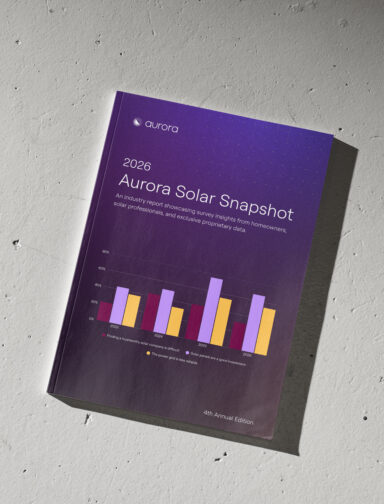
The natural response to more competition is to compete on price. Cut your margins. Offer a better deal. Get to the number before the other company does. But the data from the 2026 Aurora Solar Snapshot tells a different story — and it’s worth paying attention to.
What’s actually winning deals
When salespeople were asked the primary reason they win deals over competitors, better reputation and reviews came in at 49%. Better customer experience came in right behind it at 48%. Lower pricing? Third, at 30%.
Read that again. Reputation and experience — both forms of trust — outrank price. In a market where homeowners are evaluating multiple bids, the number that wins isn’t always the lowest one.
In theory, this isn’t a new insight. But seeing it this clearly in the data, from actual salespeople, puts it in a different light. Trust isn’t a soft benefit. It’s a variable that can really tip the scale.
And trust isn’t built in the closing conversation. It’s built in every interaction that precedes it — starting with how the proposal looks, how the numbers are explained, and whether the homeowner feels confident that what they’re being shown is accurate.
| Tip: Customizing your proposal templates is an effective way to highlight your reputation and stand out against the competition. Learn how to customize your proposal templates. |
The accuracy problem
Here’s the uncomfortable truth about the solar sales industry: It has a trust deficit, and a lot of it is self-inflicted.
Aggressive tactics. Inflated production estimates. Proposals that look great but don’t survive contact with the actual roof or actual consumption data. These aren’t just ethical issues — they’re commercial ones. In a market where 15% of homeowners cited policy or incentive uncertainty as the top reason they backed out of deals and another 21% cited overall project costs, hesitation is already at a high baseline. A proposal that doesn’t hold up under scrutiny makes that hesitation worse.
The salespeople who are winning on reputation aren’t winning because they got lucky with a good Google review. They’re winning because they built a process where the numbers check out, the design is accurate, and the homeowner feels like they’re being leveled with — not sold to.
How the proposal is presented — the clarity of savings estimates, the accuracy of system design, the credibility of production numbers — increasingly determines the outcome. As homeowners evaluate more bids, confidence in the data matters as much as the equipment.
| Tip: Design accuracy and speed don’t have to be trade-offs. Trained on over 4 million runs, Aurora AI enables teams to create 3D site models in 10 seconds or less, without sacrificing accuracy. Learn more about Aurora AI. |
Standing out in a crowded market
30% of salespeople expect their market to stay “about the same” competitively — but that shouldn’t be interpreted as breathing room. The market contraction of the past two years means there are fewer total deals, not fewer competitors. The same number of reps are chasing a smaller pool. What used to be enough — a solid pitch, a reasonable price — doesn’t differentiate anymore.
The salespeople who are building durable advantages in this environment share a few things in common. Their proposals are professional and accurate. Their follow-up is consistent. Their process moves quickly from first meeting to signed agreement, which reduces the window for homeowner doubt. And they can speak with confidence about the numbers — not because they’ve memorized a script, but because they trust the data behind them.
The rep who shows up with a clear, credible proposal and a smooth path to contract is a different experience than the rep with a generic PDF and a financing brochure. Homeowners feel that difference. And increasingly, they’re choosing accordingly.
Read the full 2026 Aurora Solar Snapshot.
This is the second article in Aurora’s 2026 Solar Snapshot series.
Check out the first article: Why solar deals stall at close — and how top reps fix it.
Next up: More options, more closes: the case for financing flexibility in 2026.